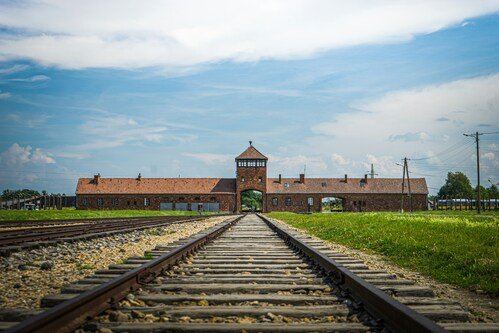
Auschwitz is not a place you visit for enjoyment – you visit it because it demands to be seen. Over 1.1 million people, the vast majority of them Jewish, were murdered there between 1940 and 1945. Standing on that ground changes you. It sharpens your understanding of what humanity is capable of, and what it must never allow again. This guide helps you prepare practically and emotionally, understand why this visit matters, and make the most meaningful trip possible.
What Auschwitz Actually Is – and Why the Scale Is Hard to Comprehend
Auschwitz-Birkenau was the largest Nazi concentration and extermination camp complex in history. It operated in occupied southern Poland from 1940 until Soviet forces liberated it on 27 January 1945 – a date now observed globally as International Holocaust Remembrance Day.
The complex consisted of 3 main parts:
- Auschwitz I – the original camp, including the infamous “Arbeit Macht Frei” gate and the preserved execution wall
- Auschwitz II-Birkenau – the extermination centre, where gas chambers and crematoria operated on an industrial scale
- Auschwitz III-Monowitz – a forced labour camp serving the IG Farben chemical plant
Reading those facts in a textbook is one thing. Walking through the barracks and seeing the piles of confiscated shoes, hair, and suitcases behind glass is something entirely different. In 1979, UNESCO inscribed Auschwitz-Birkenau on the World Heritage List – not as a celebration of human achievement, but as a permanent warning and call to vigilance.
Planning Your Visit in 2026
Getting to Auschwitz and navigating the site takes preparation. Here is everything you need to know before you go.
Getting There from Kraków
Auschwitz-Birkenau sits in Oświęcim, approximately 70 km west of Kraków, which remains the natural base for most international visitors. You have several transport options:
- Train – Regular connections run from Kraków Główny station; journey time approximately 1.5–2 hours
- Bus – Direct buses depart from Kraków’s main bus station; journey time approximately 1.5 hours
- Guided tours – The most popular option for independent travellers. For a detailed overview of how these tours work, read this article about trip to Auschwitz from Krakow, which covers logistics and practical tips in depth
- Private transfer – KrakowDirect offers private transfers directly to the memorial, which suits families, groups, or anyone who wants flexibility without public transport logistics
Book Your Tickets Before You Arrive
Reserve your tickets in advance. The Auschwitz-Birkenau Memorial and Museum uses a mandatory reservation system. Entry is free, but timed tickets require advance booking – especially between April and October when demand peaks. Guided tours in Polish, English, German, French, Hebrew, and many other languages also require advance reservation.
How Long Should You Stay?
Allow a minimum of 3–4 hours – a full day is strongly recommended. Birkenau alone covers over 170 hectares. Rushing through the site does a disservice to the memory of those who suffered there.
Practical Tips for the Day
- Wear comfortable, weather-appropriate clothing – you will walk several kilometres on uneven ground
- Dress respectfully – avoid clothing with slogans or logos
- Bring water and a small snack – the on-site café can have long queues
- Keep your phone on silent – you can photograph most areas, but handle it with sensitivity
- Children under 14 are not recommended due to the graphic nature of the exhibitions
Why This Visit Matters
Holocaust denial is active in 2026. Misinformation circulates on social media and extremist movements promote false narratives across multiple countries. The physical evidence at Auschwitz – the gas chambers, the crematoria ruins, the mountains of personal belongings – directly counters those lies.
When you walk through the site, you become a witness. As the number of living Holocaust survivors declines, the responsibility of remembrance shifts to all of us. Auschwitz teaches lessons that reach far beyond history:
- How dehumanisation creates the conditions for violence
- How bureaucratic systems can be weaponised against entire populations
- How ordinary people become perpetrators through obedience and conformity
- How unchallenged prejudice escalates into genocide
These lessons apply directly to debates about civil rights, migration, and political extremism happening right now.
“First they came for the Socialists, and I did not speak out – because I was not a Socialist…” – Pastor Martin Niemöller
This quote, displayed at Holocaust memorials worldwide, captures the universal lesson Auschwitz teaches: indifference enables atrocity.
Responsible Tourism at Auschwitz
Auschwitz sometimes appears under the label of “dark tourism”, but that framing risks trivialising what the site represents. This is a cemetery and a crime scene, preserved so humanity does not forget. Respect the memorial’s clear behavioural guidelines:
- No smiling selfies, particularly near the gas chambers or execution wall
- No loud or disrespectful behaviour at any point during the visit
- Remove nothing from the site – doing so is illegal and deeply disrespectful
- Eat nothing near the main exhibition areas
If you can align your visit with a commemorative event, do it. The International March of the Living – held annually on Yom HaShoah – brings thousands of participants from around the world to march the 3 km between Auschwitz I and Auschwitz II-Birkenau. It remains one of the most powerful acts of collective remembrance available to anyone.
After Your Visit: Keep the Conversation Going
The experience does not end when you leave the site. Talk about what you saw when you get home – not to shock people, but to keep the conversation alive. In an era when Holocaust survivors are dying and revisionism is growing, every person who visits and speaks honestly about it becomes part of the chain of memory.
Continue your education through these resources:
- Books: Night by Elie Wiesel, Maus by Art Spiegelman, The Diary of a Young Girl by Anne Frank
- Films: Son of Saul (2015), Shoah (1985), The Pianist (2002)
- Organisations: The USC Shoah Foundation, Yad Vashem, and the Auschwitz-Birkenau Memorial and Museum all offer extensive online resources
Conclusion
Visiting Auschwitz means choosing to face the worst of what humanity has done – and committing, however quietly, to doing better. The site is accessible, the reservation system is straightforward, and guided tours run in most major languages. What requires no reservation, no planning, and no budget is the choice to pay attention – to stand in those barracks, read those names, and understand in your body, not just your mind, what happened there.
That is why Auschwitz belongs on every traveller’s list. For truth. For responsibility. For the 1.1 million people who deserve to be remembered by name, not just by number.